

Navigating CDM regulations 2015: Ensuring safety in construction
The Construction (Design and Management) Regulations 2015, commonly known as CDM 2015, set out how health, safety and welfare should be managed throughout construction projects in Great Britain. The CDM Regulations apply across the project lifecycle, from the pre-construction phase through the construction phase and project completion.
This article explains the scope of the Construction (Design and Management) Regulations 2015, the roles and responsibilities of key participants, and the principles that help organisations manage health and safety risks. It also looks at how digital tools can support construction teams in implementing consistent safety processes and maintaining accurate records.
CDM 2015 distinguishes between commercial and domestic clients. The duties described below apply in full to commercial clients, while domestic client duties normally transfer to the contractor or principal contractor.
Understanding the Construction (Design and Management) Regulations 2015
CDM 2015 places responsibilities on the organisations and individuals involved in a construction project. Clients, designers, principal designers, principal contractors and contractors all have specific roles in planning, managing and monitoring health and safety.
The table below provides an overview of their main roles and responsibilities:
| Duty-holder | Responsibilities |
| Clients |
|
| Principal Designers |
|
| Principal Contractors |
|
| Designers |
|
| Contractors |
|
These roles illustrate the coordinated approach required by CDM 2015. Effective cooperation between the client, designer and contractor teams, principal designer and principal contractor helps identify hazards, reduce risks and improve health and safety throughout the project.
Key principles for CDM 2015 compliance
CDM 2015 requires health and safety to be considered throughout the project rather than treated as a separate activity. Effective implementation depends on collaboration, competence, risk management, accurate information and worker involvement.
Collaboration and coordination
- A key aspect of CDM 2015 is the emphasis on cooperation among all parties involved in a construction project. This collaborative approach ensures that health and safety considerations are integrated into every stage of the project, from conception through to completion.
- Effective coordination between clients, designers, contractors, the principal designer and the principal contractor helps identify potential hazards early and ensures that appropriate control measures are communicated across the project team.
Skills, knowledge and experience
- Ensuring that all individuals involved in the project possess the necessary skills, knowledge, and experience is fundamental to the successful implementation of CDM 2015. This competency extends beyond technical abilities to include an understanding of health and safety risks and the measures required to manage them.
- Training and continuous professional development play a vital role in maintaining a competent workforce, equipped to deal with the dynamic nature of construction safety challenges.
Risk management
- The regulations advocate for a proactive approach to risk management, encouraging project teams to identify health and safety risks at the earliest possible stage and eliminate, reduce or control them wherever practicable.
- Regular risk assessments and reviews ensure that control measures remain effective throughout the construction phases, adapting to changes in the work environment, design or project scope.
Documentation and record-keeping
- Effective CDM management depends on relevant information being created, maintained and shared throughout the project. This can include pre-construction information, risk assessments, the construction phase plan and, where required, the health and safety file.
- Maintaining accurate digital records provides an audit trail and makes important safety information easier to retrieve and share across the project team.
Engagement and involvement
- Engaging all workers and ensuring they are informed about the health and safety aspects of their work fosters a culture where safety is prioritised. Worker involvement in safety discussions and decision-making processes enhances their commitment to complying with safety protocols and reporting potential hazards.
By applying these principles, organisations can support compliance with the Construction (Design and Management) Regulations 2015 while creating a more consistent approach to managing safety across the construction site.
How digital safety management can support CDM 2015
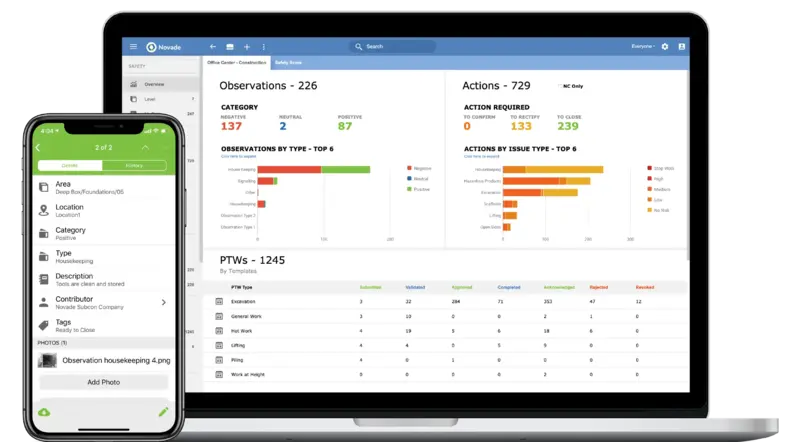
Digital construction safety tools can help organisations manage many of the processes associated with CDM 2015 more consistently. Novade construction safety software enables field and office teams to manage safety workflows, capture reliable data and maintain visibility across construction projects.
Digitalisation of safety processes
- Digital forms and workflows can be used to manage processes such as risk assessments, RAMS, site inductions, toolbox talks and safety documentation. Information captured on site is available to authorised teams in real time, improving communication and reducing reliance on fragmented paper records.
Real-time reporting and analytics:
- Real-time reporting gives project managers and safety teams greater visibility of risk assessments, inspections, incidents and corrective actions. Analysing this data can help identify recurring health and safety risks and support more proactive decision-making.
Inspections and monitoring
- Regular safety inspections help teams monitor conditions on site, identify issues and assign corrective actions. Digital records also make it easier to demonstrate that inspections have been completed and actions followed through.
Control of high-risk work
- Where a permit-to-work system forms part of the control measures for higher-risk activities, digital Permit to Work software can help teams manage risk assessments, approvals, worker credentials and active permits. This gives the principal contractor and safety teams greater visibility of controlled activities taking place on the construction site.
Digital tools do not replace the responsibilities established by CDM 2015. However, they can help organisations standardise safety processes, maintain accurate records and improve health and safety management across projects.
Conclusion:
The Construction (Design and Management) Regulations 2015 establish a framework for managing health, safety and welfare throughout construction projects. Successful implementation depends on clear roles and responsibilities, effective coordination, proactive risk management and reliable information throughout the project lifecycle.
Digital safety management can support these requirements by connecting risk assessments, inspections, permits, incidents and other field processes in one system. By giving project teams better access to safety data and greater visibility of site activities, organisations can reduce administrative effort and focus more effectively on identifying and managing risk.
Related content
Construction safety software UK
The safety platform behind UK’s most demanding projects
Safety inspection app
Safety inspection software & mobile app Simplify compliance, inspections, and audits on your jobsites Free for up to 5 users and 5 projects Get…

Best construction safety software in the UK: 8 platforms compared
Construction safety software can help contractors replace paper-based processes and standardise safety workflows. It can also give teams real time visibility of risk across…